- Pictures
- Damage Patterns
- Biology
- Propagation
- Pest Control
- Biological Control
- Historicals
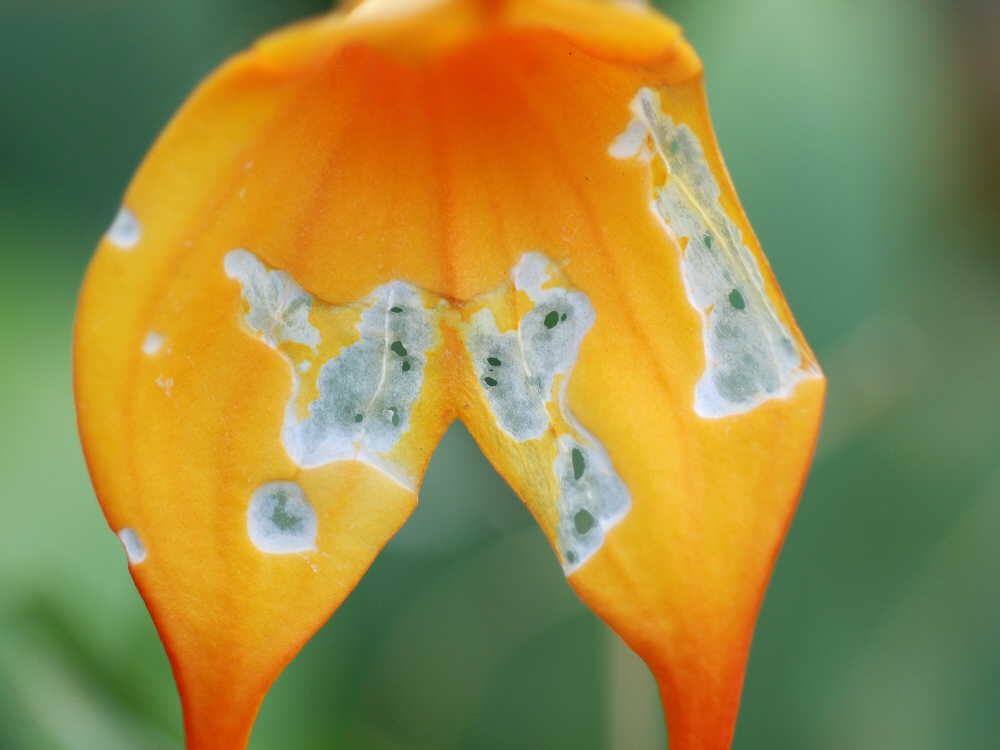
All butterfly caterpillars can cause significant damage to plants and flowers. However, one pest is particularly prevalent in horticulture: the gypsy moth (Duponchelia fovealis Zeller). This harmful butterfly originates from southern Europe and is mainly found in cold greenhouse crops and refrigerated Phalaenopsis. The moth is approximately 19-21 mm long, brown to brownish-black in colour with lighter rings on its abdomen. Its long, upward-curving abdomen is characteristic. The insects usually sit under leaves and fly away quickly when disturbed. The caterpillars are 2-3 cm long, white in colour with many small brown spots. Their heads are dark. The caterpillars feed in very hidden places, usually on the surface of the substrate or in the top layer of soil. There, fine webs can be seen under which the animals are protected and later pupate.
Pyralid moths are nocturnal and have a slender body, long legs and a well-developed proboscis. The front wings are elongated and triangular, while the rear wings are equipped with adhesive bristles. The name probably comes from 'zünzeln', an old word meaning "to flicker" or "to flicker", which dates back to the time of the first street lamps.
Duponchelia fovealis, the orchid moth, reproduces by means of eggs laid by females in the substrate. The caterpillars hatch after approximately 8 days and pupate after 4 weeks. The entire development from egg to moth takes 6–8 weeks, depending on the temperature. In a greenhouse, 8–9 generations can develop per year.
Life Cycle
- Egg: Pink in colour, laid in groups and change colour before hatching.
- Caterpillar: Hatch after approx. 8 days, are yellowish-brown with a black head and live in webs, often at the base of stems, eat plant material and excrete a lot of faeces.
- Pupation: The caterpillar forms a cocoon, often with organic material, and pupates in the soil or plant.
- Moth: Hatches after about a week, lives for about 10 days and lays up to 200 eggs.
Chemical plant protection must be carried out consistently and repeatedly with contact insecticides. In the event of infestation, at least 2-3 treatments must be carried out at intervals of 2 weeks. There are also growth regulators that prevent the animals from moulting, thus interrupting their life cycle.
In horticulture, the use of parasitic wasps (Trichogramma sp.) is recommended.
Hypoaspis predatory mites can be used against various soil-dwelling pests. The mites bite the eggs shortly before the larvae hatch.
Insect-pathogenic nematodes (Steinernema sp.) can also be used for biological control. Repeated application can lead to a significant reduction in the number of larvae within a short period of time.
Bacteria offer good results as insect pathogens. Strains of Bacillus thuringiensis (so-called B.t. preparations) are effective against harmful moths. The bacterium multiplies in infected insects and forms permanent spores there.
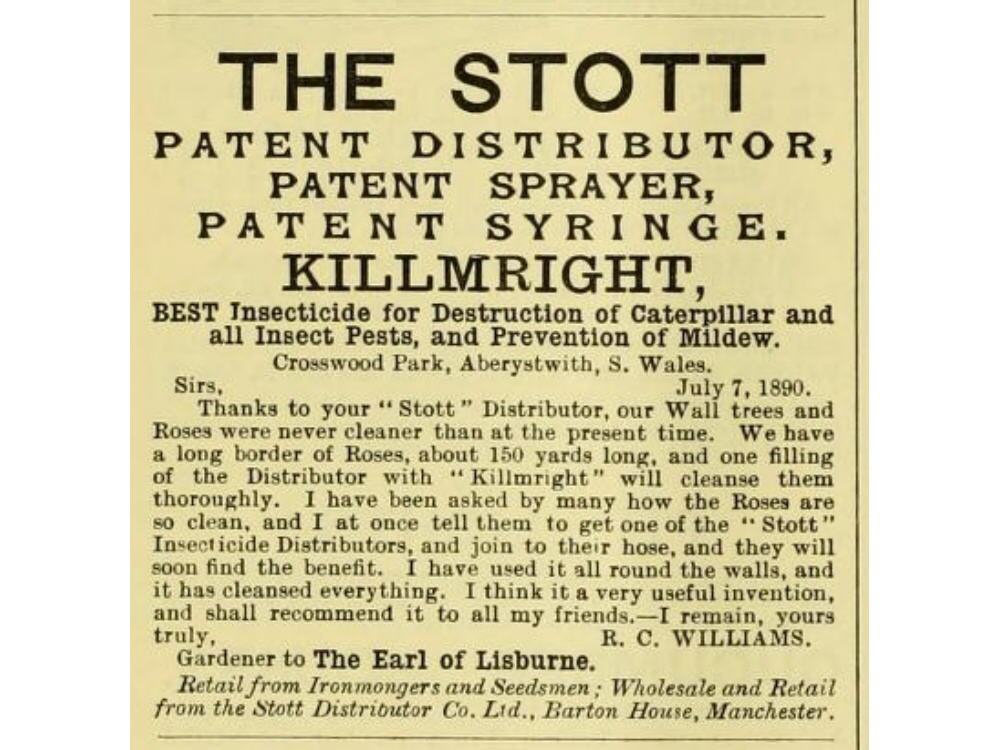
These treatment methods from 1872 are for informational and entertainment purposes only. Please note that the use of some of the chemicals mentioned here is no longer permitted today, as they can be harmful to health (including that of the user) and very harmful to the environment. Reading, thinking and smiling are allowed, but do not try this at home.
The name of the product says it all: KILLMRIGHT = Kill Them Right.